


 Note: This was the head on our previous boat, Webfoot, a MacGregor 26. While we no longer have a composting head, we are happy to answer any questions, so feel free to send us an email.
When we purchased Webfoot, it came fully equipped with a used(!) porta-potty. Some of the parts were missing, so the blue liquid (also kindly included) would slosh out if the boat rocked too much. Luckily for us, the compartment that holds the “human” liquids was well sealed.  Needless to say, the potty had to go. But now we were left with the question of what to replace it with. The male captain among us voted for going off the back of the boat and simply using the head for storage. I would not hear of that. Sailing does not need to be uncivilized. So we debated getting another porta-potty, but after learning on our old boat that one has to walk to the pump-out station carrying the entire potty and then very ungracefully dump it into a hole covered in… you get the picture. This would not do.
We thought about a regular marine head, but those were quickly vetoed due to limited space for a holding tank. If you’ve ever read Janna Cawrse Esarey’s book, The Motion of the Ocean, you would know what can happen during a routine pumpout. I don’t want to ruin it for you, but it’s not pretty (read the book; it’s hilarious). If you have a marine head or have been reading these blogs for some time, you will know that there is an endless stream of maintenance issues and repairs involved with heads requiring many gloves and cleaning products. So after much research, we came across another alternative: The Composting Head. This nifty device separates the “solids” from the “liquids.” By doing so, it allows the “solids” to become usable compost by mixing it with a material such as COIR. The “liquids” are stored in a semi-transparent bottle that can be safely transferred to a regular toilet in a grocery sack. Since the “liquid” is non-toxic, it can also be safely disposed of in areas where it is legal, without any harm to the environment. The solids tank has to be emptied when it gets full—every few weeks or months, depending on use. It’s best to let the mix finish composting, but that is not always feasible if you don’t have a garden at your disposal. It can be emptied into a plastic garbage bag and tossed with regular trash (much like used diapers and dog poo).
Speaking of being environmentally friendly: The average American uses 7,665 gallons of water per year just to flush the toilet. That is 21 gallons per day! By installing a composting head, we not only eliminated many unpleasant tasks but also made a small contribution to saving the earth!
If it’s working correctly, it doesn’t smell!
TECHNICAL NOTES
We have gotten a lot of questions regarding our Nature’s Head, and I hope to answer some of them here. We purchased a Nature’s Head rather than the AirHead because we like the molded-in seat in the Nature’s Head—no seat to slide around in seas. We also thought the Nature’s Head looked sturdier and appears to be a very well-built unit with all stainless steel parts. Remember, if it smells, something is wrong. We spent over a week in the San Juan Islands, and it started to smell towards the end. I’m fairly sure it was due to high moisture content, and we should have added more composting material, which we hadn’t thought to bring along. For the next trip, we bought some enzymes to speed up the composting process. Since adding a dash of enzymes on occasion, we have had absolutely no smells!
For composting material, we use small bricks of coconut pith (COIR) available at your local hardware store or nursery. Since the bricks are very compact, they are easy to store and much better than using peat, since peat cannot be as sustainably harvested.
We installed the solar fan in the window as well as the supplied fan at the toilet; the latter seems to draw a lot more air and uses hardly any power at all. We could easily do without the solar fan.
The install was straightforward. We cut a 4″ hole into our head window to add a vent, removed the old potty, and drilled two holes to secure the new head with supplied screws.
All in all, we spent around $1000 on the project and think it was well worth it. 
UPDATE 2024
We have now had two full-time boats with marine heads. Camille had a VacuFlush head, and Limerick had two Jabsco electric heads. While we thought the composting head was great for a weekend boat, I can’t imagine having it on a full-time boat. I would rather empty the holding tank once a week than deal with a bucket full of (very) stinky pee every day.
The main reason I would not have a composting head on our liveaboard boat is that separating liquids and solids is easy enough for men, but not so much for women. And what if you had eaten something bad?!
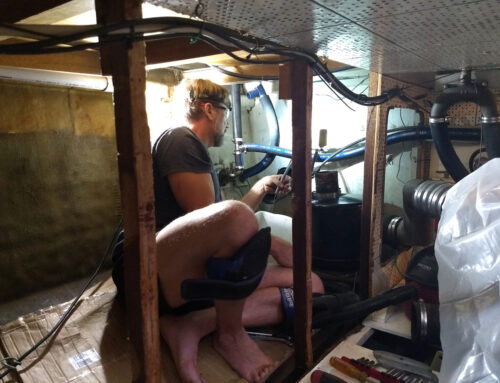
I’ll leave you with a picture of Limerick’s heads, both of which have Jabsco electric heads. We now have a zero-smell system after replacing all the hoses, pumps, and other components. We use this incredible digester in our toilets to keep things clean. This stuff neutralizes odors and liquifies sludge instead of using deodorizers to simply mask the smell. Furthermore, no harmful chemicals are used. If you have old, foul-smelling hoses, leave the digester sitting in your hoses overnight and thank me later.


Forward Head




Great information. I had no idea there were composting heads out there. I’ll have to check into this. Thanks.
Remove the top/seat part. Then just invert the base into a trash-bag. Most 13 gallon tall kitchen garbage bags will fit over the base. No need clean the interior of the solid waste container as composting will continue from the residual matter clinging to the sides.
To clean the residue from the liquids container add a 2 liter bottle of coke and let sit over night.
So glad I found your post (via Ceildyh’s blog.) We are installing our Nature’s Head this weekend.
Question for you. How do you empty the solids area when it gets full? The liquids area is straightforward, but not so sure about the back half.
Joe, We have found than when we use the Drain Care enzymes it all processes a lot faster. We just add a generous dash out of a spice shaker after using the solids tanks. We’ve been using it all summer and are still nowhere near full and have had NO smells! The liquids tank last 2-4 days for the two of us. Nature’s Head Composting Toilets are certified as Coast Guard Type III MSD devices and meet all “No Discharge” regulations.
The nature’s head website has lots more info: http://www.natureshead.net/marine.html
Send me an email if you want to know more. I’d be happy to answer any questions. Just go to my blogger profile and click on email.
What about solid disposal (process, frequency or number of uses, volume, etc.)? Also legality since I’m planning to cruise the Florida Keys this winter? This looks like a very cool alternative to what I’ve been considering. Thanks, Joe (Sailing the Judy B a 2001 Mac x)
Thanks for this link – I actually had read about this on your site before…its definitely something to consider, but with the very LOOOOONG list of things we have to do (and soooo little time), we’ll most likely just hook up a smaller tank (because that will be, more or less, turnkey)…but I really like this idea…perhaps we could install something like this later on?
Allan – Thanks for your comments. We’ve updated this post with some technical notes. Hope they help. Let me know if you have more questions.
LOVE the idea.
What make /modle did you use ?
Any concerns installing ?
Approx cost ?
I want to replace the aging potta potty on my 26 M
Thanks for the info