


This article is also featured in the March print edition of 48° North Magazine.
We recently spent six months cruising from Spain through France, Italy, Greece, and Turkey, before returning to Greece. On this incredible Mediterranean adventure, we often found ourselves comparing the experience and our surroundings to our home cruising grounds in the Pacific Northwest.
We were aboard a power catamaran for this trip, which was the perfect platform for the Mediterranean. Our exploration of the Salish Sea, from Puget Sound to the northern end of Vancouver Island, over eight years, was aboard our 1980 Monk 36 trawler, Limerick—also a fairly perfect boat for cruising this area.
The Pacific Northwest has always offered a unique blend of beauty and logistical challenge, but we’ve never appreciated our home waters so much as when we saw how foundational they were to voyaging around the Mediterranean. While the scenery changes, the core skills required to cruise the Med are remarkably similar to those honed on the Salish Sea. Here are our observations on the parallels and divergences of these two magnificent cruising regions.
Scenery
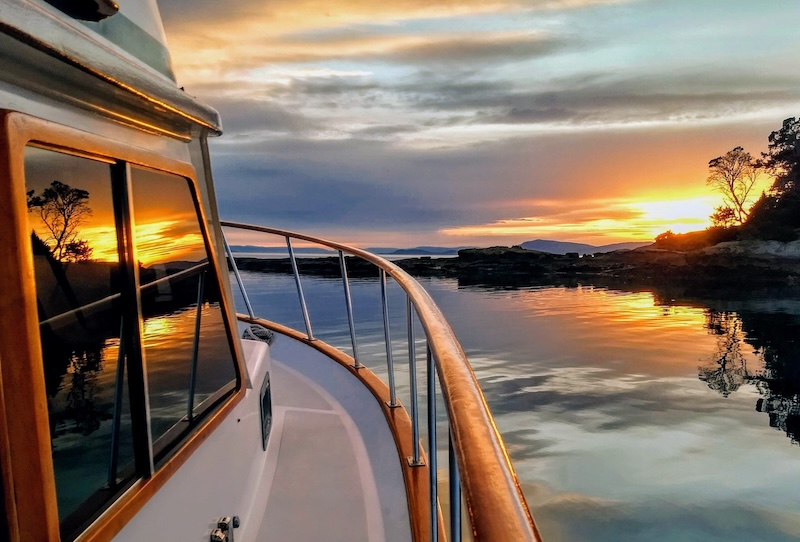
The rugged wilderness of the Salish Sea is hard to beat. With its dense evergreen forests and snow-capped mountains, the coastline has a much different scale than the Mediterranean. It feels like true wilderness.
In contrast, the visual interest in the Med is oftentimes tied to something man-made. Ancient stone structures, terraced hillsides that have been tended for centuries, and coastal villages built into the rock—all surrounded by crystal clear water.

Limerick anchored and shore-tied in Desolation Sound.
Shoreside
Once you are north of Puget Sound, and especially north of Nanaimo, there are few facilities on shore. This makes the Salish Sea a cruising ground where self-sufficiency is prized and often required. You need to be your own mechanic and chef, as reprovisioning and repairs can be challenging. If there isn’t a trail nearby, getting out in the kayak or dinghy is the best way to explore the shoreline. Though even in the most remote areas, there can be signs of human presence—sometimes you find an overhanging tree with a rope swing, or ancient petroglyphs and settlements of the Indigenous peoples who have lived along these coasts since time immemorial.
No matter where you are in the Mediterranean, thousands of years of civilization will be on display. While the Med definitely has secluded, natural anchorages, many more offer cultural and social experiences. One of our favorite memories was hiking to the ruins of an ancient city with Greek tombs and cisterns—it wasn’t a tourist destination, just an unmanaged piece of history where we were the only people around. In the Cyclades Islands, we discovered small, family-run tavernas offering Greek hospitality and fresh-caught seafood. Often, moorings are provided for overnight stays, with the only cost being your patronage. The bill was typically in the 30-dollar range, including wine. On the water and ashore, you are never far from something that connects you to Europe’s long history—whether it’s miles-long handcrafted stone walls or ancient breakwaters still protecting the local fishing fleet.

Mike trying out a rope swing in Desolation Sound, and Verena at the entrance to an ancient cistern.
Anchoring & Docking
The Salish Sea was the perfect training ground for the Mediterranean. In many ways, a shore-tie is just the wilderness version of a Med-moor. Both require backing toward shore while dropping anchor and securing the stern to keep the boat from swinging. Whether you’re tying to an ancient quay in Greece, a busy marina in France or Italy, or a ring in a quiet British Columbia cove, the mechanics are the same. The only real difference is whether you’re stepping onto a concrete pier or paddling over to barnacle-covered rocks.

Med-moored in Greece.
In the Med, we were able to really hone our anchoring skills. The water is so clear that you can see exactly how the anchor behaves once it’s dropped. Unlike the dark depths of the Salish Sea, where you rely entirely on the feel of the chain, the Med gives you the visual confirmation of seeing the anchor bury itself in the sand and the chain pay out along the bottom. The coast of Turkey is actually quite similar to the Salish Sea, with a steep and deep tree-covered shoreline, so we shore-tied quite frequently there.
 Anchored and shore-tied in Turkey.
Transportation
Unless you want to spend all your time at a marina, a dinghy is nonnegotiable in both cruising regions. We use it for shopping, fishing, and reaching our favorite trails in the Salish Sea, some of which lead to freshwater swimming lakes. We also love complementing our dinghy with a kayak or paddleboard, which makes shore-tying much easier and is a more immersive way to explore the shoreline.

In Greece, we spent hours exploring limestone grottos. These sea caves are only accessible with a small boat. Once inside, the sunlight reflects off the sandy bottom, giving the water a blue glow.
Regardless of the location, a stern anchor is essential to keep the dinghy from chafing against a rocky beach or concrete quay—another stern tie setup, but with the boat reversed. A bungee anchor line is especially useful; it keeps the dinghy safely offshore but allows you to pull it back to the beach at almost any stage of the tide. For more details, see our post on setting up your dinghy for cruising success.

Swimming & Diving
We visited the Mediterranean during winter and spring, and the water was fairly cold. Mike swam nearly every day, but I needed a very sunny day to get in. Mid- to late summer is the best time to visit if you want warm water.
Surprisingly, despite the Salish Sea’s predominantly cold water, some fjords can reach over 70°F (21°C) in the summer at the top layer. Best of all, Vancouver Island blocks the clouds, leaving that part of the Salish Sea with plenty of sunshine.
Mike freedives frequently, mostly to check the anchor and explore the anchorage, but we haven’t done any scuba in either location. Since we were in the Med in winter and early spring, a 2-3 mm wetsuit was needed, but in the Salish Sea, you need a 5 mm suit and a high tolerance for the cold. While you can find warm surface water temperatures in certain fjords, you’ll encounter a thermocline just a few feet down that drops the temperature by 20 degrees instantly.

Basking in the warm surface water of Desolation Sound and freediving in crystal-clear water in Greece.
Wildlife
We didn’t see much underwater wildlife in the Med. As with the scenery above the water, the most interesting finds are usually human artifacts, such as shipwrecks. We spotted a few small groupers among the rocks and speared some invasive lionfish in Turkey.
The Salish Sea, by contrast, has amazing wildlife, from orcas, octopus, and osprey to seals, sea lions, and salmon. Given the right timing, the fishing is outstanding, and oysters, mussels, and clams can be picked right off the rocks from your kayak. Since we like fishing while in the water, we enjoy diving for crab and shellfish in this part of the world. Keep a close eye on the charts; many of the best anchorages are inside Rockfish Conservation Areas (RCAs), which have strict bans on spearfishing.

Bringing home fresh salmon for dinner in the Gulf Islands.
When it comes to large sea life, the Mediterranean experience is a bit more subtle. Though we had a magical moment with a huge pod of dolphins and hundreds of sea turtles floating past as we crossed the Ionian Sea from Italy to Greece, the sea itself can feel rather devoid of wildlife. Our most exciting “wildlife” encounters were actually on land. Sheep and goats freely roam the hillsides; their jingling bells like distant windchimes.
Seas
In the Mediterranean, swells have room to build over a thousand miles from Gibraltar, which can generate dangerous, steep, short seas. While the Salish Sea doesn’t have as much fetch, seas can build rapidly when the wind blows, especially against the tide, making for a very wet ride. The Straits of Juan de Fuca or Georgia can provide some local context for the Mediterranean’s short chop—when it’s rough, it’s nasty. Thankfully, in both locations, seas settle quickly after a big blow, and mariners can make many miles on perfectly flat waters.
Wind
Wind has pinned us to the dock in Nanaimo for days while waiting to cross the Strait of Georgia. Once you get into the fjords around Desolation Sound, there’s very little wind, and you can usually find a quiet place to anchor and get a good night’s rest even when it’s blowing in the strait.
Conversely, anchoring in the Mediterranean requires constant weather monitoring. Winds can shift unexpectedly, bending around islands and capes, turning a seemingly calm anchorage into a long, sleepless night. It’s no surprise the Mediterranean has the highest concentration of specifically-named local winds in the world. In both locations, it’s almost always either too much wind or not enough wind for a sailboat.
We mostly used PredictWind for weather routing in the Med. It was really helpful for visualizing how the wind changes throughout the passage. The only drawback is that you cannot set the comfort level to less than 2.5-meter waves. For the Med, our preferred comfort threshold is one meter or less.

Leaving Mount Etna in our wake for our overnight to Greece, in perfect seas.
Tides
The Mediterranean Sea has only about a foot of tidal change, so it’s not much of a factor. The Salish Sea, on the other hand, has an average tidal range of eight to twelve feet, and even more as you go farther north. Changing depths must be considered when anchoring, and narrow passes must be timed with great accuracy to avoid the strongest currents, which can exceed 12 knots in places. One book we found helpful in tackling the timing of the passes was “Local Knowledge” by Kevin Monahan.
Logs
We made several overnight passages in the Med after carefully picking our weather windows. Cruising at night is never really easy, but fewer risks are hiding in those waters than at home. In the Salish Sea, we would never attempt to be underway in the dark due to the deadheads and logs that could end a trip very badly. One of our friends learned this lesson the hard way—he got a log jammed in his prop during the maiden voyage of his brand-new boat, severely damaging it. It’s particularly challenging after King Tides or heavy rains, but logs are a part of life and an ever-present concern in the Pacific Northwest.
Cruising Guides
In the Med, we primarily used the Navily app to find marinas and anchorages. Users can post photos and descriptions of anchorages, and partner marinas can provide quotes instantly. Navily isn’t as widely used in the United States and Canada, but there are many alternative options. We mostly use the Salish Sea Pilot, an interactive, digital cruising guide in PDF format with beautiful chartlets of all anchorages, including where to shore-tie or drop the hook.

Checking Navily while underway from Italy to Greece.
The Verdict
If you are preparing for the cruising life, the Salish Sea is the ultimate training ground. It will teach you how to become self-sufficient, manage tidal currents, handle limited shore support, and anchor like a pro, all while sheltered from the open ocean. The Salish Sea provides the invaluable lessons you need to sail the world.
While the Salish Sea builds your technical foundation, the Mediterranean hones those skills through constant weather vigilance and high-precision maneuvering. You’ll learn to anticipate how local winds bend around ancient headlands and master the finesse of dropping anchor in crystal-clear water with inches to spare between your neighbors.
If we could only return to one, where would we go? Between the rugged coast of the Salish Sea and the historic landscapes of the Mediterranean, we find it impossible to choose—one feeds the soul with awe-inspiring wilderness, while the other enriches it with thousands of years of human story. We’ll simply let the wind and tide decide, trading one spectacular horizon for another. Which would be your choice? Let us know in the comments!
If you are looking for captain services for a charter, boat delivery, or boat sitting, please contact us or visit our other website at PacificCaptains.com.

Many thanks to our boating mentors for showing us the way!! Our choice: Salish Sea now. Med later!
Excellent choice!!
Verena and Mike, this piece was very well written. It captivated me and my favorite would be the Salish Sea. Besides the story behind the sailing my favorite part is the two people I know and love. Aunt Ruthie
Awww, thanks Ruthie! Love you, too!